Vocabulary
Sumo words you will hear at the show
A short glossary of the terms an MC is likely to use, from the dohyo to the tachiai, with where each one comes from in sumo.
Book the sumo show ↗Quick answer
A handful of Japanese words cover most of what happens at a sumo show: dohyo for the ring, rikishi for the wrestler, gyoji for the referee, tachiai for the charge, kimarite for the winning technique and shiko for the stomp. This guide defines each from published sources, so the MC's English makes immediate sense.
The short answer
Learn six words and you can follow most of a show: dohyo, rikishi, gyoji, tachiai, kimarite and shiko. Each is defined below from Wikipedia and its glossary. The listing says an English-speaking MC guides the show, so you do not need Japanese, but the words help when the MC names a technique or a ritual and you want to connect it to what you are watching.
Dohyo, the ring
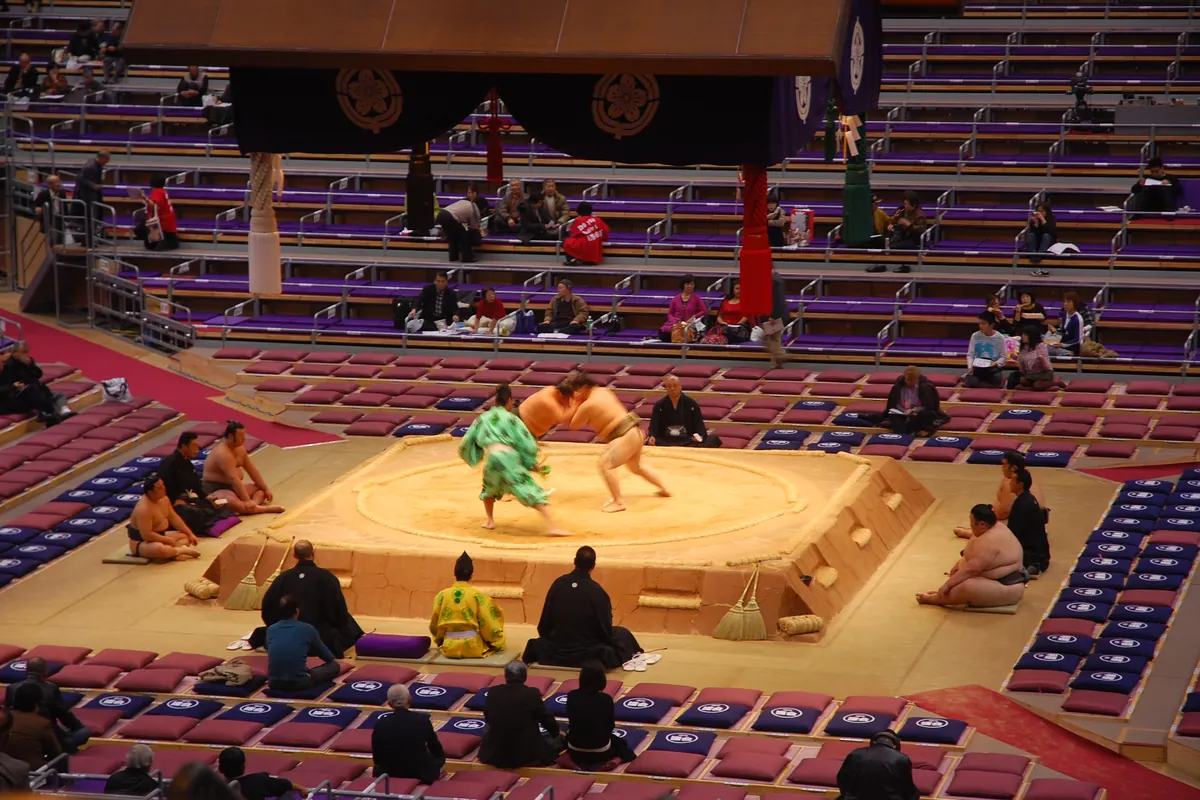
The dohyo is the ring in which a bout takes place. Wikipedia says a typical one is a circle 4.55 metres across, bounded by partly buried rice-straw bales, and that in tournaments it sits on a square platform of clay. Two white starting lines mark where the wrestlers crouch. A bout is decided when a wrestler is forced out of the circle or touches the clay with any part of himself other than the bottoms of his feet.
Rikishi and gyoji
Rikishi is the word for a sumo wrestler. The gyoji is the referee, who directs the match and, in tournaments, is supported by five judges, called shimpan, Wikipedia says. In a show the referee role may be played differently, and the listing does not describe it. When the MC introduces the performers, expect the word rikishi, and the show's own retired wrestlers to be introduced as such.
Mawashi, the belt
The mawashi is the belt a sumo wrestler wears. Wikipedia explains that in a bout the wrestlers grab each other's mawashi and use it to throw or force the opponent out. The style of fighting built on that grip is called yotsu-zumo, while pushing an opponent out without a firm grip is oshi-zumo. If the MC mentions either style, it is describing how the wrestlers use their hands.
Tachiai, the charge
Tachiai is the initial charge that begins a bout, a word made from the Japanese for stand and meet, Wikipedia says. Wrestlers may charge head first, thrust at the chest, slap the face, grab the belt, or dodge aside. The listing calls the show's single bout a tachiai, which suggests the charge is the moment to watch. The listing does not describe how the bout is staged.
Kimarite, the winning technique
A kimarite is the technique that wins a bout, announced by the referee at the end. The Japan Sumo Association recognises 82 of them, Wikipedia says, but only about a dozen are used often. The most common frontal moves are the push out, oshidashi, and the belt-grip force out, yorikiri. The listing promises famous techniques but does not say which, so the MC's commentary is the key.
Shiko, the stomp
Shiko is the exercise in which each leg is raised as high and as straight as possible and then stamped down, repeated hundreds of times in training, according to Wikipedia's glossary. It doubles as a ritual that is meant to drive off demons ahead of a bout. It is the likeliest move to be named during a training demonstration, though the listing does not say which exercises the show includes.
Chikara-mizu and salt
Two small rituals come before a bout. Wrestlers rinse the mouth with chikara-mizu, power water, in a way Wikipedia compares to the rite before entering a Shinto shrine. They also throw salt into the ring as a symbolic cleansing. The listing promises sacred rituals, and these are the best-known ones, so they are worth watching for, though the listing does not say which the show performs.
Honbasho and banzuke
A honbasho is a Grand Tournament, and there are six each year. The banzuke is the ranking list that sets out the whole hierarchy, published two weeks before each tournament, Wikipedia says. You will not need either word at the studio show, but both come up as soon as you ask how the show relates to the real competition, and the March Osaka tournament is the one nearest to hand.
Frequently asked questions
What does dohyo mean?
It is the sumo ring. Wikipedia describes a circle 4.55 metres across, bounded by partly buried rice-straw bales.
What is a kimarite?
A kimarite is a winning technique. The Japan Sumo Association recognises 82, though only about a dozen are used often.
What is a tachiai?
The initial charge at the start of a bout, from the Japanese words for stand and meet.
Is Japanese needed at the show?
No. The listing says an English-speaking MC leads the show.
Sources